Japanese art covers a very wide range of styles used by many famous artists. Those styles include ink paintings, sculptures, calligraphy on paper or silk, woodblock prints, ceramic, origami, and as well as manga. The preferred artistic expression in Japan is painting with a brush. During the Edo period, colorful woodblock prints were more favored while the use of sculpture during this period was a less sympathetic medium for expression. Ceramics are some of the longest and most frequently used to this day of art including the earliest known artifacts in Japanese culture. I will be presenting three works of well known art that was created in Japan.

Also known as The Great Wave, is a woodblock print created by Hokusai who is a ukiyo-e artist. It was published in the late Edo period as the first print in his series Thirty-six Views of Mount Fuji. This particular piece is Hokusai’s most well known print and in my opinion, the most beautiful.
This print shows the giant wave threatening to crush three boats off the coast of Kanagawa while the bold Mount Fuji hides behind. It shows strength in the midst of an occurring disaster. The balance of colors are used gracefully to distinguish the different between the light and dark. The texture allows us to see the details in the waves and boats. The shape of the overall subjects in order to to see the differences between the beginning and end of the waves. Every little detail that Hokusai shows in this print displays how Japanese art was presented during his time.
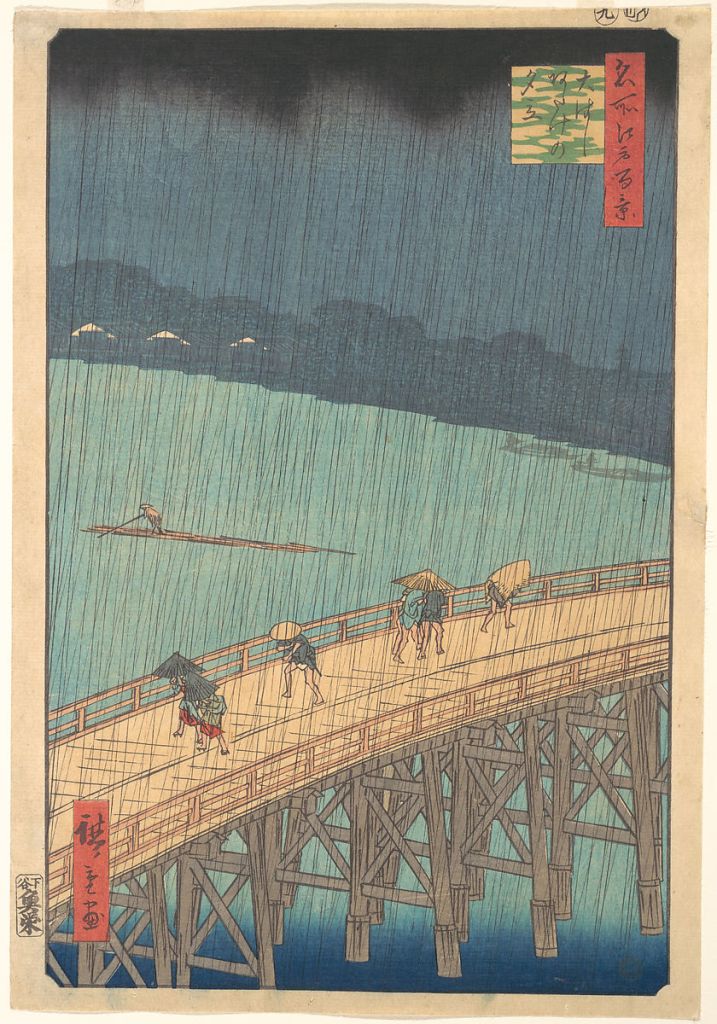
This is a woodbloc print un the Ukiyo-e genre that was created by the japanese artist Ano Hiroshige. It was created and published in 1857 as part of the One Hundred Famous Views of Edo and is one of the most famous pieces created by him in his series. His series of prints depicted 119 views of famous places in particular areas in Tokyo. This was a unique way of showing different variation of landscape views. After the 1855 Edo earthquake, Hiroshige presented many newly rebuilt/repaired buildings.
This painting shows a total of six people crossing the bridge as they shelter themselves under hats and umbrellas as the rain comes pouring down over the Sumida River. The overall style of the print is very similar to the first one I presented. The balance of colors is apparent between background and the vibrant contrast of browns that make the bridge. In the back of the painting, you can see the boatman rowing his log raft towards shelter in the Fukagawa timber yards. The overall painting is simple but shows the basic yet interesting architecture during this time.

Wind God and Thunder God is two folding screens, also known as Byobu created by Ogata Korin who was a Rinpa Artis. Japanese artist Tawaraya Sotatsu created the original piece depicting Raijin, the god of lightning, and Jujin, the got of wind, fighting each other after the well known Japanese mythology. Korin was a very famous Japanese panted, designer and lacquerer. This painting is now at the Tokyo National Museum.
This piece is very interesting in relation to the gods shade and structure. Although their body is very similar, their faces are different expressing what they were each feeling at that very moment. The space between the two gods is calm and quiet before chaos hits. The texture is significant with the gods and detail around them. Ogata Korin did a great job balancing out the darker and lighter colors.
My Thoughts
Every photo that I have presented really depicts Japanese culture and art during the Edo period. Personally, I have found the first one, The Great Wave off of Kanagawa, to be my favorite. The use of colors is more apparent and it is something that I would buy. The last painting that I showed had a greater story due to the fact that it was based off of Japanese mythology. I find it far more interesting upon the three but I would purchase the first one.
Citation
“Japanese Art.” Wikipedia, Wikimedia Foundation, 1 Dec. 2019, https://en.wikipedia.org/wiki/Japanese_art#:~:targetText=Japanese Art covers a wide,a myriad of other types.
“Sudden Shower over Shin-Ōhashi Bridge and Atake.” Wikipedia, Wikimedia Foundation, 20 June 2019, https://en.wikipedia.org/wiki/Sudden_Shower_over_Shin-Ōhashi_bridge_and_Atake.
“The Great Wave off Kanagawa.” Wikipedia, Wikimedia Foundation, 27 Nov. 2019, https://en.wikipedia.org/wiki/The_Great_Wave_off_Kanagawa.
“The Wind and Thunder Gods|About the Works|TSUZURI Project.” TSUZURI Project|Canon, https://global.canon/en/tsuzuri/works/18.html.
“Wind God and Thunder God (Kōrin).” Wikipedia, Wikimedia Foundation, 11 Nov. 2018, https://en.wikipedia.org/wiki/Wind_God_and_Thunder_God_(Kōrin).
“Ōhashi Atake No Yūdachi 名所江戸百景 大はしあたけの夕立 Sudden Shower over Shin-Ōhashi Bridge and Atake (Ōhashi Atake No Yūdachi), from the Series One Hundred Famous Views of Edo (Meisho Edo Hyakkei) 1857.” Metmuseum.org, https://www.metmuseum.org/art/collection/search/55433.
 TAYLOR'S BLOG