Japanese Art
Japanese art covers a very wide range of styles used by many famous artists. Those styles include ink paintings, sculptures, calligraphy on paper or silk, woodblock prints, ceramic, origami, and as well as manga. The preferred artistic expression in Japan is painting with a brush. During the Edo period, colorful woodblock prints were more favored while the use of sculpture during this period was a less sympathetic medium for expression. Ceramics are some of the longest and most frequently used to this day of art including the earliest known artifacts in Japanese culture. I will be presenting three works of well known art that was created in Japan.

Also known as The Great Wave, is a woodblock print created by Hokusai who is a ukiyo-e artist. It was published in the late Edo period as the first print in his series Thirty-six Views of Mount Fuji. This particular piece is Hokusai’s most well known print and in my opinion, the most beautiful.
This print shows the giant wave threatening to crush three boats off the coast of Kanagawa while the bold Mount Fuji hides behind. It shows strength in the midst of an occurring disaster. The balance of colors are used gracefully to distinguish the different between the light and dark. The texture allows us to see the details in the waves and boats. The shape of the overall subjects in order to to see the differences between the beginning and end of the waves. Every little detail that Hokusai shows in this print displays how Japanese art was presented during his time.
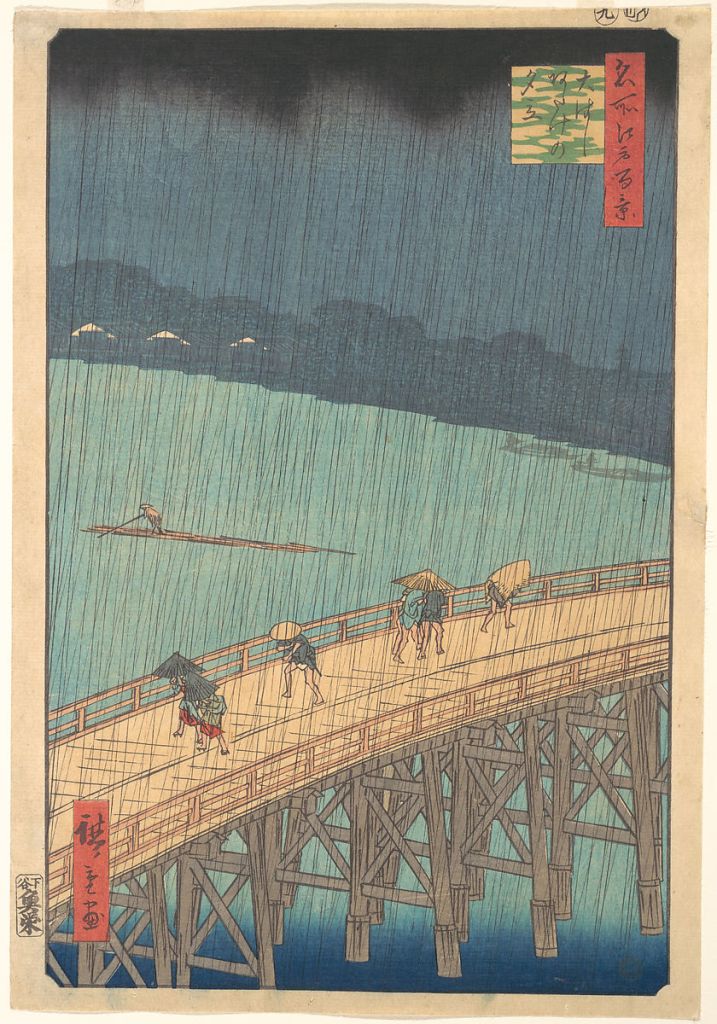
This is a woodbloc print un the Ukiyo-e genre that was created by the japanese artist Ano Hiroshige. It was created and published in 1857 as part of the One Hundred Famous Views of Edo and is one of the most famous pieces created by him in his series. His series of prints depicted 119 views of famous places in particular areas in Tokyo. This was a unique way of showing different variation of landscape views. After the 1855 Edo earthquake, Hiroshige presented many newly rebuilt/repaired buildings.
This painting shows a total of six people crossing the bridge as they shelter themselves under hats and umbrellas as the rain comes pouring down over the Sumida River. The overall style of the print is very similar to the first one I presented. The balance of colors is apparent between background and the vibrant contrast of browns that make the bridge. In the back of the painting, you can see the boatman rowing his log raft towards shelter in the Fukagawa timber yards. The overall painting is simple but shows the basic yet interesting architecture during this time.

Wind God and Thunder God is two folding screens, also known as Byobu created by Ogata Korin who was a Rinpa Artis. Japanese artist Tawaraya Sotatsu created the original piece depicting Raijin, the god of lightning, and Jujin, the got of wind, fighting each other after the well known Japanese mythology. Korin was a very famous Japanese panted, designer and lacquerer. This painting is now at the Tokyo National Museum.
This piece is very interesting in relation to the gods shade and structure. Although their body is very similar, their faces are different expressing what they were each feeling at that very moment. The space between the two gods is calm and quiet before chaos hits. The texture is significant with the gods and detail around them. Ogata Korin did a great job balancing out the darker and lighter colors.
My Thoughts
Every photo that I have presented really depicts Japanese culture and art during the Edo period. Personally, I have found the first one, The Great Wave off of Kanagawa, to be my favorite. The use of colors is more apparent and it is something that I would buy. The last painting that I showed had a greater story due to the fact that it was based off of Japanese mythology. I find it far more interesting upon the three but I would purchase the first one.
Citation
“Japanese Art.” Wikipedia, Wikimedia Foundation, 1 Dec. 2019, https://en.wikipedia.org/wiki/Japanese_art#:~:targetText=Japanese Art covers a wide,a myriad of other types.
“Sudden Shower over Shin-Ōhashi Bridge and Atake.” Wikipedia, Wikimedia Foundation, 20 June 2019, https://en.wikipedia.org/wiki/Sudden_Shower_over_Shin-Ōhashi_bridge_and_Atake.
“The Great Wave off Kanagawa.” Wikipedia, Wikimedia Foundation, 27 Nov. 2019, https://en.wikipedia.org/wiki/The_Great_Wave_off_Kanagawa.
“The Wind and Thunder Gods|About the Works|TSUZURI Project.” TSUZURI Project|Canon, https://global.canon/en/tsuzuri/works/18.html.
“Wind God and Thunder God (Kōrin).” Wikipedia, Wikimedia Foundation, 11 Nov. 2018, https://en.wikipedia.org/wiki/Wind_God_and_Thunder_God_(Kōrin).
“Ōhashi Atake No Yūdachi 名所江戸百景 大はしあたけの夕立 Sudden Shower over Shin-Ōhashi Bridge and Atake (Ōhashi Atake No Yūdachi), from the Series One Hundred Famous Views of Edo (Meisho Edo Hyakkei) 1857.” Metmuseum.org, https://www.metmuseum.org/art/collection/search/55433.
“Camp” in Post Modern Art
Post modernism is a philosophical term that is used in art, architecture, fashion, and design. It was found to follow the modern art period. It uses more of a purity of technique and art form that steers away from the pre-occupation of post war modernism. In post modern art, you can see the combined styles of art that were seen in classical and baroque.
Camp is essentially anything you want it to be. It’s a sense that over-the-top, ugly, abstract, unique, and misunderstood objects can be looked at as beautiful art. I have found that in culture nowadays the theme “camp” is everywhere. In the 20th century, it became more recognizable on the streets, in art, film, music and many other forms of expression. In this post, I will be analyzing 6 different pieces of art in which I interpret as “camp ” that were created by Joseph Havel, Samuel Bak, and Robert Rauschenberg.
Joseph Havel is a post modernism artist and sculptor that was born in Minneapolis, Minnesota. He is well educated with an MFA; Received at Pennsylvania State University and a BFA; received at University of Minnesota.
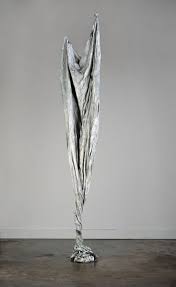
Between 1996-2006, Havel presented 30 sculptures that were shaped from cloth and cast in bronze. The second sculpture presented, Torn and Twisted Curtain is one of the pieces he created. It’s almost motionless as if it’s floating in a space with no gravity. It is simple yet shows that a lot of time and effort was put into it. The contrast from the shadows give the sculpture life and the texture makes the sheet look as if its soft and blowing in the wind. The balance between a realistic and fantasy effect is incredible. He made something simple into something extrordinary. I would interpret this piece as camp due to the unique use of a plain and boring sheet and sculpting it into something that no one would think of.
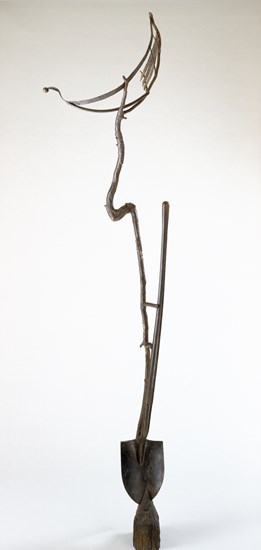
The first sculpture, Moon, June, Spoon, an odd yet satisfying sculpture. It shows a unique way of using everyday objects to create art. The contrast between the background and sculpture itself gives it a 3D effect. The way the shovel, and other forms of inanimate objects are used shows how anything can be used in order to create a masterpiece. There is very minimal color or texture that is utilized aside from the texture of the rusted shovel and old branch used to create the moon.

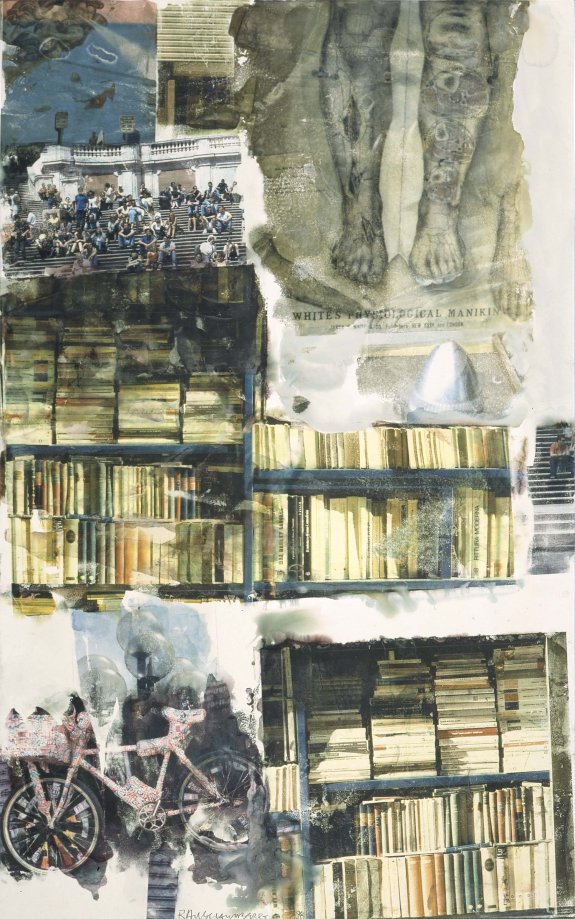
Robert Rauschenberg was a postmodern Artist that created digital color transfers from his own photography using inkjet dyes. In his famous Anagram series, his use of transferring the images using handheld burnishing is more apparent instead of using an electric press. The top two unique pieces were created by Robert Rauschenberg.
The Mirthday Man, shows a skeleton surrounded by many random themes. The colors are vibrant and the contrast between each object is apparent. The Skeleton is placed at the center of the frame gearing you to look directly at it. The use of colors are particular in objects that are needed to stand out. It gives off a fun and exciting vibe showing that the no plan is needed to create something amazing.
The Bookworms Harvest is my favorite piece between the two. It’s scholarly and intelligent with the use of a variety of books and diagrams. It’s almost comforting to look at this piece. There’s minimal amount of color used yet there is so much detail. He did an amazing job with the balance of books, people, and relative objects shown. There is so much contrast with the vague photos presented.
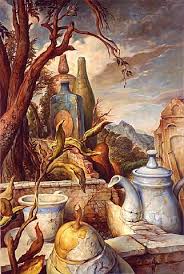

Samuel Bak is an American post modern painted and writer that survived the holocaust and moved to Israel in 1948 then spent the rest of his time in America since 1993. He’s a conceptual artist that implements different styles and “vernaculars”. He employed metaphor and allegory instead of painting direct scenes.
Both clearly show the style of painting that he uses. In Memorabilia II, the color balance is incredible with the detail in the up front focused objects. There is clear texture and shapes used in the fruit, tree, tea pot, and bottles. The theme of the painting seems to have came from an inspiration of a tea party that took place in a beautiful and rural location. The highlights of the particular moment is shown as your eyes are drawn to the meticulously pained pea, cup and tea pot.
Soutine Street is another painting that vaguely shows the famous tea cup that is presented in some of his well known art pieces. This painting is interesting with an abstract-like view of a street in a small village. It’s almost a cold and dark mood with broken up buildings and roofs. He uses a color balance of red, tan and dark colors to help create the mood that is frequently felt. There’s contrast between the buildings and background that makes the important elements more prominent.
MY THOUGHTS
All these art pieces apply to the camp theme due to their artistic creativity. Being able to implement objects and techniques that no one else has yet to utilize is a way to begin something incredible in the artistic community. It sets yourself apart from the rest and I believe that this is what these artists have done in post modern work. My favorite piece out of the six that I have presented would be Bookworms Harvest created by Robert Rauschenberg. He created pieces that are so unique that is mesmerizing. The use of random objects put into a single frame makes you think a second longer and spend more time unraveling it and finding the meaning to it compared to the rest. It’s odd yet interesting to where it makes it an incredible masterpiece.
Citations
“Anagram (1995–97).” Robert Rauschenberg Foundation, 21 Oct. 2014, https://www.rauschenbergfoundation.org/art/series/anagram#:~:targetText=Anagram (1995–97),transferred to paper using water.
“Campy Art and Why We Love It.” Widewalls, https://www.widewalls.ch/campy-art-definition-artworks-culture/.
Johnson, Patricia C. “Joseph Havel’s Cloth Work Twists, Turns and Stands on Its Own.” Houston Chronicle, Houston Chronicle, 24 July 2011, https://www.chron.com/entertainment/article/Joseph-Havel-s-cloth-work-twists-turns-and-1559099.php.
“Postmodernism.” The Artists, 4 Dec. 2018, https://www.the-artists.org/postmodernism/#:~:targetText=A few of the famous,Daniel Flahiff, and Hans Haacke.
“Samuel Bak.” Wikipedia, Wikimedia Foundation, 16 Sept. 2019,
The Influence of African Americans in Early Modernism
The Harlem Renaissance was a social, intellectual, and artistic explosion in Harlem, New York. This early 20th century was a cultural movement aimed to establish racial equality between whites and African Americans. During this time, an artistic explosion occurred with many pieces amongst artists which depicted hard times that took place during the Harlem Renaissance. I will be discussing the three Early Modern Artists; Jacob Lawrence, Faith Ringgold and William H. Johnson.

Jacob Lawrence was an African American artist known for portraying African American life by telling stories in his vibrant work. He is among one of the best known 20th century African American Painters. At just the age of 25, he created the famous 60 panel Migration Series in which depicted the migration of African Americans to the U.S. for work and bringing it to life. As son of migrants, Jacob Lawrence had a personal connection to his work which showcased on the canvas itself. His paintings are now shared between Phillips Collection in Washington, D.C. and MoMA. This particular piece, The Migrants arrived in Great Numbers was his 40th piece among 60.
Lawrence referred to his vivid and colorful art as a dynamic cubism style. Migrants travel from right to left across a dull field touched with shadows of greens and yellows underneath each group of people. The painting is simple yet brought to life with the contrasts of light and dark colors. Shapes form the gliding individuals across the canvas in such gracefulness. The men are dressed in black as the women and children are dressed in color almost in a symbolic tone. The young boy on the far top left joyously swings his bags back in forth behind his parents. With each individual looking straight forward with no emotion, the boy purposely stands out showing a crucial role of optimism for the possibility of a better life. With only an average of 6 vibrant colors in this piece, it is brought to life while bringing a powerful message.

Faith Ringgold was known for her oil paintings and gorgeous quilts in the 1960s which carried strong political rights that supported the civil-rights movement. She demonstrated this “against exclusion of black and female artists by New York’s Whitney Museum of American Art and the Museum of Modern Art in 1868-1870).” This particular piece is a part of Ringgold’s American People Series which confronts racism and equality in the 1960s. This is a mural painting which concludes the serious of beautiful paintings. This painting shows the riots that were occurring throughout across the country.
This painting is dark and dramatic showcasing bright blood splatters across the canvas among interracial men, women, and children. It’s almost confining as if escape is not an option. Everyone is dressed in vibrant colors and business attire as she was attempting to lighten up a horrific scene. The people dressed in business attire is almost symbolic showing that high class civilians are the ones that should be held accountable for the riot. Every shape and structure of each individual is similar among the men women and children the show that there’s not much different between races. The two children, one white and the other African- American, cling on to each other horrified with bright blue tears streaming down their cheeks. The texture is apparent in the clothing, hair, and faces bringing the painting to reality.

This painting was created by William H. Johnson, a major American artist during this time. He created many pieces over a period of many years across many continents. He spent time in France during the late 1920s in order to learn the basic skills of modern art. Overtime, his work was more emotional and expressive making it more prominent towards the audience. He completed hundreds of oil paintings, watercolors, pen-and-ink sketches, block prints, silk screens, gouaches, and ceramics throughout his career as an artist. he also shows forms of Cubism, Fauvism, Impressionism, and German Expressionism.
This painting takes place around 1943 during the Harlem riots. An African American woman is shown getting arrested and once a soldier, also African American, intervened, he was shot and wounded by the officer. This painting shows a lot of emotion with the structure of each individuals face. The shapes and colors are vibrant and apparent in the man and woman being arrested as well as the walking bystanders. The officers are bland with color and appear to be emotionless while acting in an inhumane way towards the civilians. Johnson created such an intricate art piece that delivers an aura of remorse and sympathy.
My Thoughts
Each of these paintings show an important part of history that should be more recognized. The painting I take more of a liking to is, The Migrants Arrived in Great Numbers created by Jacob Lawrence. The other paintings focus more on a negative point during the Harlem Renaissance when the riots took place and people were murdered or seriously injured. As for the piece created by Jacob Lawrence, he captured an empowering moment for African Americans that traveled to the U.S. for work and a better living. It represented hope and goals which is what I believe in. I know that compared to the other paintings it doesn’t necessarily have as much detail, but it tells an incredible story.
References
Everett. “William H. Johnson.” Smithsonian American Art Museum,
https://americanart.si.edu/artist/william-h-johnson-2486.
“Harlem Renaissance.” Literary Movements for Students: Presenting Analysis, Context, and Criticism on Literary Movements, Encyclopedia.com, 20 Oct. 2019,
“Jacob Lawrence.” Wikipedia, Wikimedia Foundation, 2 Nov. 2019,
https://en.wikipedia.org/wiki/Jacob_Lawrence.
Lawrence, Jacob. “Jacob Lawrence. The Migrants Arrived in Great Numbers. 1940-41: MoMA.” The Museum of Modern Art, https://www.moma.org/collection/works/78539.
“Migration Panel 40. The Migrants Arrived in Great Numbers.” Focus on African American Artists, 1000 Museums, https://focusonafricanamericanart.com/product/migration-panel-40-the-migrants-arrived-in-great-numbers/.
Ringgold, Faith. “Faith Ringgold. American People Series #20: Die. 1967: MoMA.” The Museum of Modern Art, https://www.moma.org/collection/works/199915?artist_id=7066&locale=en&page=1&sov_referrer=artist.
Russeth, Andrew. “MoMA Acquires and Hangs a Major Early Faith Ringgold -.” ARTnews, 19 July 2016,
http://www.artnews.com/2016/07/18/moma-acquires-and-hangs-a-major-early-faith-ringgold/.
Romantic Era
The Romantic Era was a movement that originated in Europe towards the end of the 18th century that involved a whole new realm of artistry, musical, intellectual and literary accomplishments. This new movement emphasized on strong and intense emotion as a source of philosophical experience in art. Romanticism celebrated individual intuition and imagination where artists found their voices across all styles of art. I will be discussing Impressionism and Post-Impressionism art during the Romantic era by four famous artists; Claude Oscar Monet, Gustave Caillebotte, Vincent van Gogh, and Paul Gauguin.
Impressionism

Paris Street, Rainy Day is a large oil painting created by the artist, Gustave Gaillebotte in 1877. This piece shows a number of individuals walking through Carrefour de Moscou, now known as Place de Dublin in north Paris. This painting was first to be presented at the Third Impressionist Exhibition of 1877 and is now located at the Art Institute of Chicago.
This shows Gaullebotte’s love for photography as each person further away shows to be “out of focus” while the one’s closest have sharp edges. The light, blue-less sky and people dressed in warm contemporary Parisian fashion indicate that the photo is set in winter. Caillebotte captures a vast, stark modernity including realistic figures walking in the foreground. Each figure is secluded from one another, consumed in their own thoughts while giving off a downcast expression. The texture is smooth while the buildings in the background fade away but show vibrant colors. The contrast between the people and buildings are drastic, showing that all the attention shall be focused on the individuals while presenting detailed architectural development. It establishes an asymmetrical composition with the stale-colored mood presenting a more “radical sensibility”.

Water lilies and the Japanese Bridge which was started in 1897 and finished in 1899, showcase two of Monet’s greatest achievements; his colorful gardens at Giverny and the series of oil paintings on canvas which were inspired by them. The time of 1883, Monet moved to Giverny and by 1893, he purchased some land which included a small brooke that he later transformed into a small Japaneses inspired oasis. This garden included exotic plants and greens which were enhanced by the famous Japanese footbridge that is featured in his painting above. This is one of a dozen paintings which show the beautiful nature of his gardens that were painted under different lighting and weather conditions.
Monet shows his skill of color balance and texture with the plants and trees reflected off the water and the three-dimensional effect of the bridge. Each leaf has a different shade of green which compliments the time of day and weather condition. The vibrant Japanese bridge shows importance displayed in the middle of the painting arching over the small pond that is covered in settle colors of pink, green and purple while contrasted with white and black detailing. The fluidity in his brush strokes create the distinct abstract-like shapes that this painting represents and is present in most Impressionist art.
Post-Impressionism

The Starry Night is an oil painting by one of the most well-known, Dutch post-impressionist painters, Vincent van Gogh. He suffered from mental illness, depression and instability for the majority of his life. In 1889, he painted this from the view of his asylum room at Saint-Remy-de-Provence before sunrise. It is currently located at the Museum of Modern Art in New York City.
This painting presents a scene of the village with a vivid crescent moon, eleven stars, and Venus. There is an array of blues contrasted with black and swirled with an abstract-like landscape of browns and greens. The mixture of yellows, blues and whites make the detail more apparent in the sky with the stars and the buildings below. The large tree presented in the front of the painting is dark and demented, taking away from the wonders of the painting that is presented. Shapes appear to be non-existent with the imaginative figures intertwined with real-life. This painting consumes viewers with the short and dashed brush strokes creating movement to the sky. It makes you feel calm in a dreamy way.

Vision After the Sermon is an oil painting created by Paul Gauguin in 1888. It is currently located in the Scottish National Gallery in Edinburgh. Gauguin first created paintings that concentrated on nature and landscapes but then started to create pieces that focused on interpreting religious events.
The use of vibrant colors, line work and shapes are very distinct in this particular painting. You can see the large areas of color composition in the red ground steer away from natural colors and shapes providing an unrealistic aura. The watching figures appear to be disfigured and distorted with exaggerated features. He uses shading frequently to contour and minimal color in the watching figures. The large tree trunk purposely divides the painting in a symbolic tone. The angel and Jacob wrestling is more apparent ensuring viewers are drawn to them.
My Thoughts
The style of Post-Impressionism is more appealing to me than Impressionism in the Romantic Era. Both styles are creative and skillfully use the balance of colors and textures. Post-Impressionism leans more towards abstract art allowing the mind to imagine even more after the artist completed the piece. Out of all of the paintings, I would own Vincent van Gogh’s, A Starry Night. It represents a calm struggle in life with the fight of realistic and imaginative shapes as well as darkness and light.
References
“A Beginner’s Guide to Impressionism.” Khan Academy, Khan Academy,
“Paris Street, Rainy Day (1877).” Paris Street Rainy Day, Gustave Caillebotte: Analysis,
http://www.visual-arts-cork.com/paintings-analysis/paris-street-rainy-day.htm.
The Editors of Encyclopaedia Britannica. “Post-Impressionism.” Encyclopædia Britannica, Encyclopædia Britannica, Inc., 1 June 2018,
https://www.britannica.com/art/Post-Impressionism.
“The Starry Night.” Wikipedia, Wikimedia Foundation, 21 Oct. 2019,
https://en.wikipedia.org/wiki/The_Starry_Night.
“The Water Lily Pond: Green Harmony (1899) Musee D’Orsay, Paris.” Water Lily Pond (1899), Claude Monet: Analysis, http://www.visual-arts-cork.com/paintings-analysis/water-lily-pond-monet.htm#analysis.
“Vision After the Sermon.” Wikipedia, Wikimedia Foundation, 28 Sept. 2019, https://en.wikipedia.org/wiki/Vision_After_the_Sermon.
Classical Era: Art and Scientific Discoveries in the 1700s
Science and art flourished in the 1700s and became more familiar with neoclassicism. Advances in science were captured in visual art while also sparking the Age of Enlightenment. Many famous scientists during this time influenced enlightenment while causing controversy as it went against religious beliefs. Many artists such as; William Blake, Joseph Wright, and Jacques Louis- David did a great job showing this in their work.
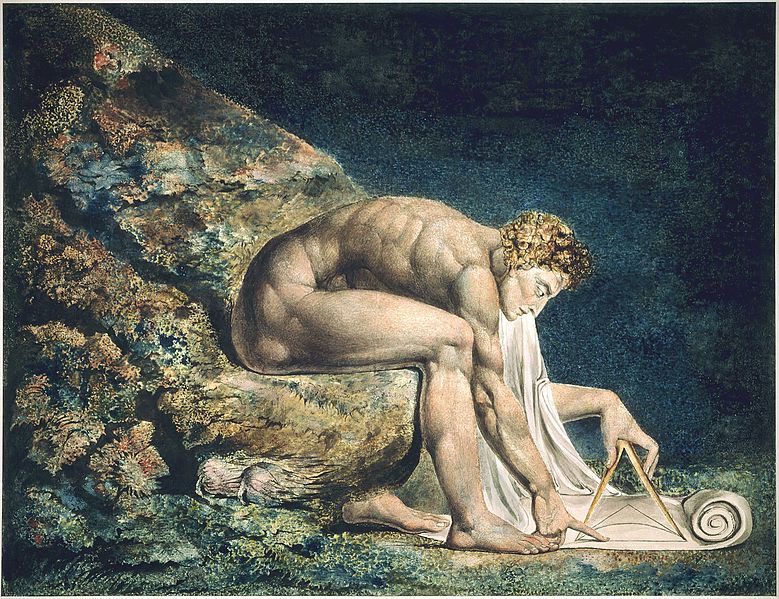
Newton, first completed in 1795 by printmaker, poet and painter William Blake. It was then reworked and reprinted in 1805. This is one of 12 large color paintings that include his series of images on the biblical ruler Nebuchadnezzar.
This painting shows Isaac Newton sitting on a rock at the bottom of the sea naked. The detail and texture on the rock is vivid with the color and shadows on the algae and barnacles that drape the natural structure of the rock. Newton is crouched over, focused on the structure of the diagrams he’s creating with a compass. It’s almost as if he’s so absorbed in his work and doesn’t notice the beauty of nature right behind him. The scroll is denoting “celestial nature” as it flows over his shoulder and onto the ground. There’s a balance of light and dark with the colors of Newton’s skin and hair contrasted with the dark background of the sea. Blake shows realistic shapes of Newton’s anatomy of great strength.
William Blake didn’t necessarily agree with Isaac Newton’s theories. Blake believed, “Art is the tree of life. Science is the tree of Death.” His opposition to the enlightenment was deeply rooted since it went against everything the Catholic Church believed and taught. According to Blake, this painting is supposed to show how negative the enlightenment effected the public during the classical era.
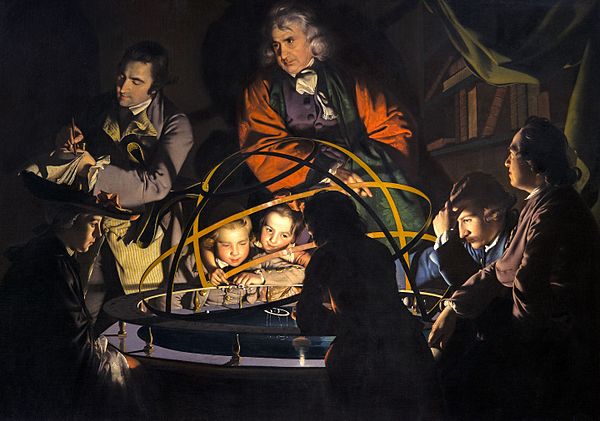
A Philosopher giving that Lecture on the Orrery in which a lamp is put in place of the Sun is a 1766 oil painting created by Joseph Wright in Derby, England. This is actually the first of some of Wright’s candlelit masterpieces. It is currently sitting in the Derby Museum and Art Gallery.
This painting shows a realist justification while depicting the scientific discovery and what it caused. This captured a moment of awe from the students and adults being taught by the philosopher about the motion of the planets and solar system. Compared to previously created art by other artist, this shows a more realistic look using textures and shape, bringing the painting to life. The colors are vibrant, especially in the philosophers which show importance. The contrast of the light from the candle and background shows how the demonstration is absorbing the attention of the viewers. He balances the the dark background with the small details in the bookcase making sure not to drown it in complete darkness.
The painting itself created by Joseph Wright caused some controversy as is also went against the Catholic Church and it’s beliefs. It also an example of the movements science created during the classical era.

Oath of Horatii was created in 1784 by Jacques Louis- David in the Louvre in Paris. This is one of the most famous painting and still, to the day is the most well known creations of the Neoclassical style.
This painting depicts a dispute between two cities (Rome and Alba Longa) that were once enemies. This moment captures the importance of patriotism and strength for the sacrifice of one’s country. Instead of going to war, each city sent three men to fight while the winning man will bring the city to victory. The painting shows the three brothers from the Horatii Roman family saluting their father who was holding their swords. The brothers mood shows confidence and respect when saluting their father before their great fight. The detail and balance in the painting as a whole shows emotion that draws in the audience. The texture in each person allows us to see the Horatii brother’s mom and sister (on the bottom right) cry due to the possibilities that might occur to their beloved family members. The colors are vibrant and apparent in the clothes, background, weapons, and shapes making it more life-like.
This painting shows how scientific discoveries impacted this particular art piece created by David while also occupying a place in French Painting. His simple use of tonal contrast helps send a message of patriotic sacrifice and nobility.
References
Cooper, L. J. “William Blake’s Aesthetic Reclamation: Newton, Newtonianism, and Absolute Space InThe Book of UrizenandMilton.” European Romantic Review, vol. 29, no. 2, Apr. 2018, pp. 247–269.,
doi:10.1080/10509585.2018.1439386.
Mayer, Tamar. “Drawing the Corporeal: Balance and Mirror Reversal in Jacques-Louis David’s Oath of Horatii.” Studies in Eighteenth-Century Culture, vol. 46, no. 1, 2017, pp. 229–260.,
doi:10.1353/sec.2017.0017.
“Wright of Derby, A Philosopher Lecturing on the Orrery.” Khan Academy, Khan Academy, https://www.khanacademy.org/humanities/ap-art-history/later-europe-and-americas/enlightenment-revolution/a/wright-of-derby-a-philosopher-lecturing-on-the-orrery.
The Anatomy Lesson of Dr. Nicolaes Tulp

The Anatomy Lesson of Dr. Nicolaes Tulp is a 1632 oil painting by Rebrandt and is sitting in the Mauritshuis museum in The Hague, the Netherlands. Rebrandt Harmenszoon van Rijn was one of the most prolific artist in Dutch art history and considered a master in visual arts. Unlike many artists, Rebrandt had a wide range of depicting his art. He did portraits, self-portraits, landscapes, different genres, historical, biblical, and mythological pieces while excelling in all areas.
This particular piece of art dates back to Amsterdam Guild of Surgeons. During this time, Dr. Tulp was the anatomist of the city. He permitted only one public dissection a year to which he allowed students, colleagues, and the public (on payment) to accompany him. When Rebrandt arrived in Amsterdam, he was appointed to do this painting by Dr. Tulp while all the men paid to be featured in his work. By doing a full length corpse in the anatomical portrait, it changed how this particular genre was seen and created more of a dramatic Mise-en-scene.
With how important it was at the time to expand the knowledge of the human anatomy, Rebrandt did a great job capturing such a strong scene. You can tell the power of Dr. Tulp by the sharp contrast in comparison to the other men present. The bare arm of the corpse shows great detail in the bones and veins almost making it apparent to the great findings the human body has yet to be discovered. Each men show such interest and awe in their facial structure hovering over the body and what seems to be a reaction of how muscles of the arm are attached. The texture in the clothing, facial features, and background bring the portrait to life as if you were there experiencing what they were experiencing. Since the variety of colors used are very minimal, Rebrandt balanced it out making it very settle with the mood this piece of art presents. Dynamism is apparent by the contrast in both light and dark shades as shown on the clothing and background.
Di Matteo, Berardo, et al. “Nicolaes Tulp: The Overshadowed Subject in The Anatomy Lesson of Dr. Nicolaes Tulp.” Clinical Orthopaedics and Related Research, Springer US, Mar. 2016, https://www.ncbi.nlm.nih.gov/pmc/articles/PMC4746154/.
“Rembrandt Van Rijn, The Anatomy Lesson of Dr Nicolaes Tulp, 1632.” Mauritshuis, https://www.mauritshuis.nl/en/explore/the-collection/artworks/the-anatomy-lesson-of-dr-nicolaes-tulp-146/.
Rosler, Roberto, and Pablo Young. “The Anatomy Lesson of Dr. Nicolaes Tulp: The Beginning of a Medical Utopia.” Revista Medica De Chile, U.S. National Library of Medicine, Apr. 2011, https://www.ncbi.nlm.nih.gov/pubmed/21879195.
Medici Madonna

The Medici Madonna is a famous marble sculpture carved by one of the most well known Italian Renaissance artist, Michelangelo Buonarroti and was created between the years of 1521 and 1534 in Florence. The sculpture was originally part of the Medici tombs between the Cosmas and Damian statues over the tomb of Lorenzo the Magnificent. It is now located at the San Lorenzo Basilica sitting at the altar of the one of the largest churches in Florence, Italy the Sagrestia Nuova.
Michelangelo was fascinated with the Virgin Mary with child theme and it was clearly presented in the majority of his art. The Medici Madonna shows the Virgin Mary holding baby Jesus. The detail in the face and body is impeccable. Michelangelo made sure that the people viewing were able to sense the emotion on the Virgin Mary’s face. The baby’s body shows strength in which the artist wanted to depict his future. Even though the sculpture remains incomplete, we cannot fail see the connection between mother and child.
The Medici dynasty commissioned several art pieces for the Basiclica de San Lorenzo. To work on the tombs of Giuliano and Lorenzo de Medici, Michelangelo joined the project. The Medici family was one of the most powerful and influential people during the Italian Renaissance when it came to art and religion. The most Iconic and beautiful art were scattered throughout the Medici chapels from many famous artists including Michelangelo.
History.com Editors. “The Medici Family.” History, A&E Television Networks, 9 Nov. 2009, https://www.history.com/topics/renaissance/medici-family
Matisse, Henrie. Medici Madonna, by Michelangelo. Michelangel Paintings, Sculptures, Biography , https://www.michelangelo.org/medici-madonna.jsp
“Medici Madonna.” Medici Madonna by Michelangelo, http://www.michelangelo.net/medici-madonna/
“Michelangelo & The Medici.” International Opulence Magazine, http://www.internationalopulence.com/michelangelo-the-medici/
The Night Watch

This is a 1642 oil painting created by Rembrant van Rijn. It’s known as one of the most famous Dutch Golden Age paintings. It is currently located in the Amsterdam Museum displayed as the most well known piece in the Rijksmuseum. The title that Rebrandt’s painting has been known by all these years is actually incorrect. The scene of this painting didn’t take place during the night, but during the day. It was given it’s title The Night Watch at the end of the 18th century when it was already darkened by dirt and varnish. This painting contains officers and men of Captain Fran Banning Cocq and Lieutenant Wilhelm van Ruytenburgh.
This oil painting shows a dramatic use of light and darkness as well as the perception of motion. While color is limited in this piece, so much emotion is shown by the shadowed look of the people and building. The Night Watch depicts bravery and potential or past victory in a way. The details in the faces, clothing, and guns show men, that once called upon, will defend cities and put riots to an end.
“Rembrandthuis.” The Night Watch , Museum HET Rembrandthuis, 3 Dec. 2018,
“Rembrandt’s Night Watch.” The Night Watch by Rembrandt Van Rijn, REMBRANDT VAN RIJN Life, Paintings, Etchings, Drawings & Self Portraits, Oct. 2018, http://www.rembrandtpainting.net/rembrandt’s_night_watch.htm
My Relation to Art
I’ve always found art fascinating. It’s a simple way to express how one is feeling or wants to feel. Drawing and painting has been an outlet for me for many years. I find myself getting more acquainted with oil paintings and how to use the different textured paint.
In places I look for comfort, I love to surround myself with both complex and simple art pieces. Traveling to cities I have never been to, art museums are always on the top of my list to see. I’m always perplexed by the the amount of emotion an artist can show on a canvas.
My favorite piece of art that I own is one that I got in a small town Antananarivo, Madagascar. It portrays the culture and nature there perfectly. It’s one that I will always hold to my heart dearly.
 TAYLOR'S BLOG